MIT Urges Supreme Court to Deny Review in Campus Antisemitism Case
MIT's brief in opposition tells the Justices the First Circuit's ruling was fact-bound, creates no circuit split, and that a broader Title VI rule would suppress political speech on campus.
By Mark L. Javitch, Esq. · August 27, 2026
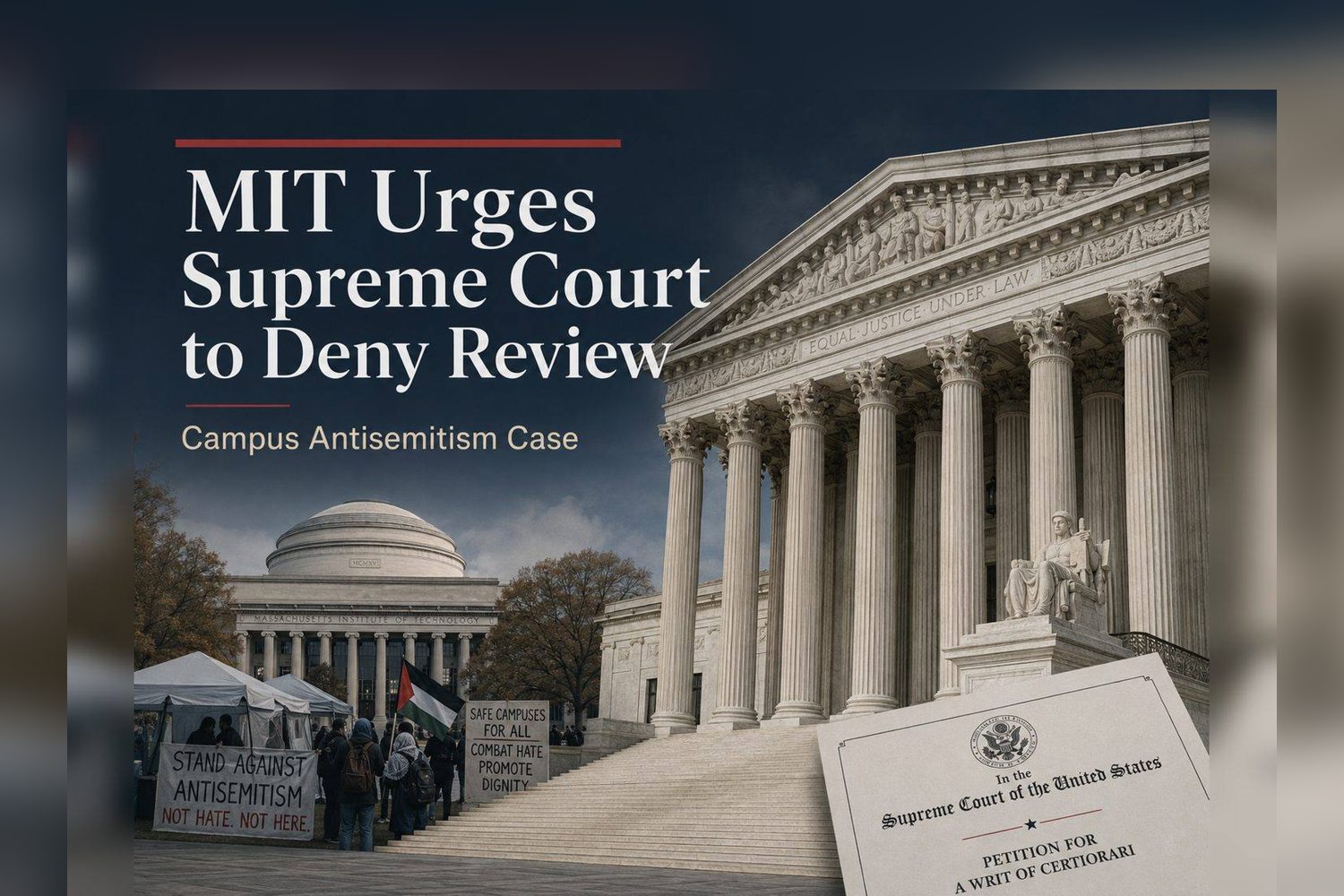
The Massachusetts Institute of Technology has asked the Supreme Court to stay out of one of the highest-profile campus antisemitism cases in the country. In a brief in opposition filed August 26, 2026, MIT urges the Justices to deny certiorari in StandWithUs Center for Legal Justice v. Massachusetts Institute of Technology, No. 25-1404.
The petition, filed June 18, 2026 by the StandWithUs Center for Legal Justice together with Katerina Boukin and Marilyn Meyers, drew eight amicus briefs supporting review. MIT's answer is the first time the university has responded at the Supreme Court.
MIT's framing
MIT opens by stating that antisemitism "has no place in the MIT community" and that it has taken "decisive steps" against it since the October 7, 2023 attacks. It then draws the line it wants the Court to accept: community members may express and vigorously debate political views, including on Israel and Palestine, so long as they follow neutral time, place, and manner rules. When students followed those rules, MIT says, leadership issued statements urging respect but did not censor speech. When students broke the rules, MIT says it escalated — condemnation, interim suspensions, formal discipline, and ultimately arrests.
The vehicle argument
MIT's lead reason for denial is procedural rather than ideological. The First Circuit affirmed dismissal on two independent grounds: that the complaint did not plausibly allege an actionable hostile environment based on race, color, or national origin, and, alternatively, that MIT was not deliberately indifferent. MIT tells the Court that the petitioners do not challenge the deliberate-indifference holding, so even a win on the questions presented would leave the judgment standing. On that reading, the case is a poor vehicle no matter how important the underlying issues are.
No split, and a fact-bound record
On the merits of the questions presented, MIT argues the First Circuit did nothing novel: it canvassed the specific allegations in this complaint and found them insufficient. There is no conflict among the circuits to resolve, MIT says, and the ruling turns on the particular pleading rather than on any general rule that harassers' subjective intent must be alleged or that protected speech can never form part of a hostile-environment record.
The free-speech warning
MIT closes with the argument most likely to shape how the Justices read the case: adopting the petitioners' position, it contends, "would result in suppression of political speech on university campuses." Citing Keyishian v. Board of Regents and the Department of Education's Office for Civil Rights Dear Colleague letters on the First Amendment, MIT frames a broad Title VI liability rule as a censorship mandate that would push universities to police protest speech to avoid suit.
What the petitioners say
The cert petition and the eight supporting amicus briefs press the opposite view: that requiring students to plead what was inside a harasser's head, and carving constitutionally protected expression out of the hostile-environment analysis, lets a university answer for each incident individually and never for the environment as a whole. The Brandeis Center and the American Jewish Committee argue lower courts apply deliberate indifference far too deferentially; the American Center for Law and Justice argues universities can now escape Title VI with minimal responses; Professor David E. Bernstein argues the whole record must be weighed when a claim alleges both expression and conduct.
What happens next
Petitioners may file a reply brief, after which the petition is distributed to the Justices for conference. Four votes are needed to grant review. Every filing in the case — the petition, all eight amicus briefs, and MIT's brief in opposition — is posted on our StandWithUs v. MIT case page, and we will add the reply, the conference date, and the Court's order as they arrive.
Nothing alleged in these filings is a finding. No court has determined whether the allegations are true.
Related Coverage
StandWithUs v. MIT: Read Every Supreme Court Brief
Eight amicus briefs back the Title VI cert petition against MIT, and MIT has now answered. Read the petition, all eight amicus briefs, and the brief in opposition.
Mark L. Javitch, Esq. · August 27, 2026
Amy Spitalnick's Charlottesville Lawsuit: Integrity First for America, Explained
Before running the JCPA, Amy Spitalnick led Integrity First for America — the nonprofit that funded Sines v. Kessler, the landmark civil suit that bankrupted the organizers of the deadly 2017 Charlottesville "Unite the Right" rally.
Staff Writer · July 16, 2026

Who Is Ari Kohen? UNL Human Rights Professor and the Holocaust Symposium Records
Ari Kohen is a UNL political science professor and human-rights scholar, now at the center of a records fight over Nebraska's Holocaust symposium.
Staff Writer · July 15, 2026
CodePink's Social Media Posts Targeting Adas Torah Synagogue Not Protected by First Amendment
Federal Judge Rules CodePink’s Social Media Posts Are Not Protected Speech — Citing “True Threat” to Jewish Synagogue Worshippers June 13, 2025 – Los Angeles, CA In a landmark decision with significant implications for the boundary between…
Staff Writer · June 13, 2025
Comments
No comments yet. Be the first to weigh in.