What Percent of California Is Jewish? 3% (City-by-City Data)
California is about 3% Jewish — 1.2 million people, #2 in the U.S. See the LA, Bay Area & San Diego numbers, and how they're counted.
By Staff Writer · August 3, 2026
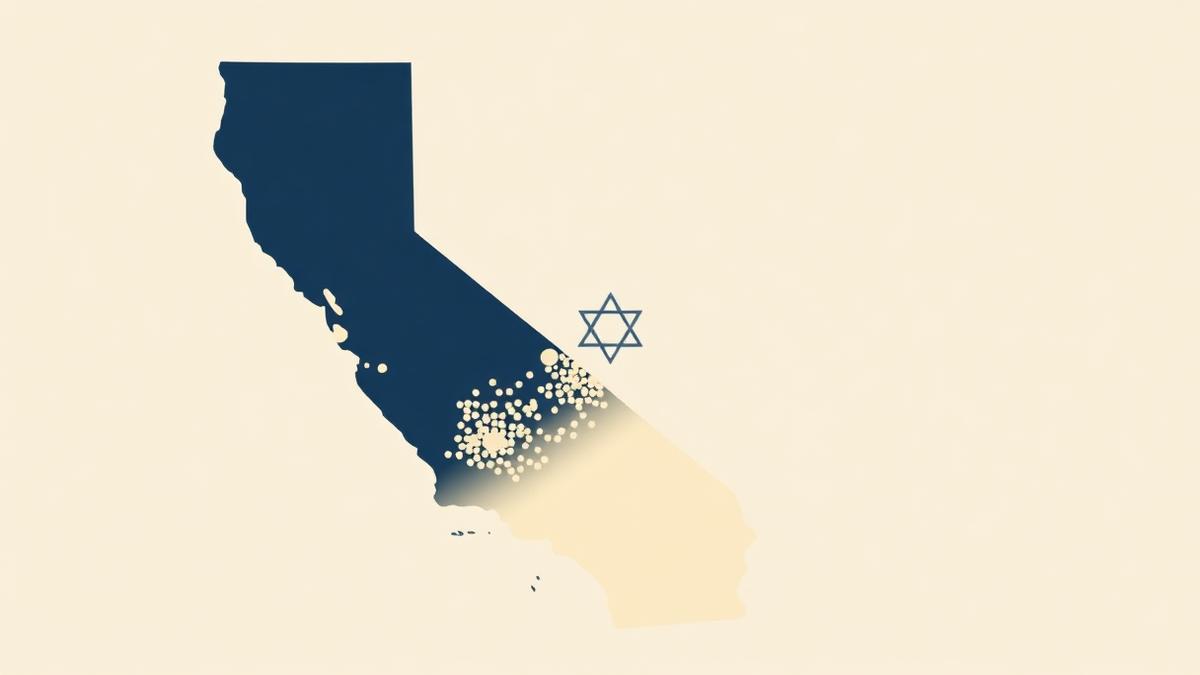
California is home to roughly 1.2 million Jewish residents — the second-largest Jewish population of any U.S. state, behind only New York. That is about 3% of California's population, and close to 18% of all American Jews. Those numbers explain why California school board votes, campus Title VI complaints, and Federation politics so often become national stories.
This guide breaks down where Jewish Californians actually live, how the counts are produced, how the population has changed, and why the demographics matter for the legal and policy fights we cover at our Jewish California hub.
California Jewish population at a glance
- Statewide: ~1.2 million Jewish residents (community studies and the Brandeis American Jewish Population Project place the figure between roughly 1.1 and 1.3 million).
- Share of state population: roughly 3%, above the national average of about 2.4%.
- Share of U.S. Jewry: roughly one in six American Jews lives in California.
- Rank: #2 nationally, after New York; ahead of Florida, New Jersey, and Massachusetts.
Where Jewish Californians live
Greater Los Angeles
Los Angeles County and the surrounding metro hold the largest concentration — on the order of 560,000 to 620,000 Jewish residents, making it the second-largest Jewish metro area in the country after New York. The population clusters on the Westside, in the San Fernando Valley, and increasingly in the Conejo Valley and Orange County suburbs. It is also one of the most internally diverse Jewish communities in the world, with large Persian, Israeli, Russian-speaking, and Sephardic populations alongside the Ashkenazi majority.
San Francisco Bay Area
The Bay Area — San Francisco, the Peninsula, Silicon Valley, the East Bay, and Marin — accounts for roughly 350,000 to 470,000 Jewish residents depending on how the region and Jewish identity are defined. The 2018 Bay Area Jewish community study found unusually high rates of interfaith households, secular and unaffiliated identity, and Jews of color relative to national figures. This is also the region where institutional power is most visible: see our reporting on who really runs Bay Area Jewish advocacy.
San Diego, Sacramento, and the rest of the state
San Diego County has roughly 100,000 Jewish residents, Sacramento and the Central Valley perhaps 30,000 to 40,000 combined, with smaller established communities in Palm Springs, Santa Barbara, Fresno, and the North Coast. Palm Springs is notable for its older and heavily retired Jewish population; university towns like Davis, Santa Cruz, and Berkeley skew young and transient.
California Jewish population by metro area
| Metro / region | Estimated Jewish residents | Share of CA Jewish population |
|---|---|---|
| Greater Los Angeles (LA + Ventura counties) | 560,000 - 620,000 | ~49% |
| San Francisco Bay Area (SF, Peninsula, South Bay, East Bay, Marin) | 350,000 - 470,000 | ~33% |
| Orange County | 80,000 - 100,000 | ~7% |
| San Diego County | ~100,000 | ~8% |
| Sacramento & Central Valley | 30,000 - 40,000 | ~3% |
| Palm Springs / Coachella Valley | 20,000 - 30,000 | ~2% |
| Santa Barbara, Santa Cruz, North Coast and other | 20,000 - 30,000 | ~2% |
Cities with the largest Jewish communities
| City | Notes |
|---|---|
| Los Angeles | Largest by far; Westside, Fairfax/Pico-Robertson, and San Fernando Valley concentrations, plus the largest Persian Jewish community outside Israel. |
| San Francisco | High rates of interfaith, secular, and unaffiliated Jewish identity. |
| San Diego | Concentrated in La Jolla, Carmel Valley, and North County coastal communities. |
| Palo Alto / Peninsula | Dense Jewish population tied to Stanford and the tech economy. |
| Berkeley / Oakland | Politically active, historically progressive congregations and campus communities. |
| Irvine / Newport Beach | Fast-growing Orange County communities with large UC Irvine student presence. |
| Palm Springs | Older and heavily retired Jewish population relative to the state. |
How these numbers are actually produced
The U.S. Census does not ask about religion, so there is no official government count of Jewish Californians. Every figure you see comes from one of three methods:
- Local community studies — random-sample telephone and panel surveys commissioned by Jewish Federations (the 2018 Bay Area study, the 2021 Los Angeles study). These are the most detailed but expensive and infrequent.
- Meta-analysis — the Brandeis American Jewish Population Project pools hundreds of national surveys to estimate state and metro totals annually.
- The American Jewish Year Book — a long-running compilation that reconciles local studies with informed estimates.
Estimates diverge mainly because of definitions. A count of "Jewish by religion" adults produces a much smaller number than a count that includes people who identify as Jewish culturally or ethnically, and both are smaller than a count of everyone living in a household with a Jewish member. When two sources disagree by 200,000, the disagreement is usually definitional rather than factual.
How the population has changed
California's Jewish population grew rapidly from the 1940s through the 1990s, driven by domestic migration from the Northeast and Midwest, then by Soviet and Iranian Jewish immigration that reshaped Los Angeles in particular. Growth has since flattened. Cost of living has pushed some younger families out of San Francisco and coastal Los Angeles toward Nevada, Arizona, Texas, and Florida, while Orthodox communities in Los Angeles continue to grow through higher birth rates. The net effect is a population that is roughly stable in size but shifting geographically and becoming more polarized between highly observant and entirely secular ends.
Why the demographics drive the legal fights
Population size and concentration translate directly into legal exposure and political leverage:
- Ethnic studies curriculum. California's model curriculum reaches millions of students, which is why the drafting fights and subsequent litigation over "liberated" ethnic studies have national consequences.
- Campus antisemitism. The UC and CSU systems, plus Stanford and USC, enroll a large share of American Jewish undergraduates, generating a disproportionate volume of Title VI shared-ancestry complaints.
- Hate crime data. California's Attorney General publishes annual hate crime reports; anti-Jewish incidents consistently rank as the most reported religious-bias category despite Jews being roughly 3% of the state.
- Institutional representation. With this many Jewish residents, Federation-affiliated JCRCs speak for a large constituency in Sacramento — a role that has drawn scrutiny when their positions diverge from the communities they claim to represent.
Frequently asked questions
How many Jewish people live in California?
Roughly 1.2 million, with credible estimates ranging from about 1.1 to 1.3 million depending on whether the count includes only people who identify as Jewish by religion or also those who identify culturally or ethnically.
What percentage of California is Jewish?
About 3% of the state's roughly 39 million residents, compared with a national figure of about 2.4%.
Which California city has the most Jewish residents?
Los Angeles, by a wide margin. Greater Los Angeles is home to somewhere between 560,000 and 620,000 Jewish residents, the second-largest Jewish metro population in the United States.
Does California have more Jews than New York?
No. New York State remains first with roughly 1.7 to 1.8 million Jewish residents. California is second.
Is the Jewish population in California growing or shrinking?
It is roughly flat. Out-migration driven by housing costs is largely offset by natural growth, particularly in Orthodox communities in Los Angeles, and by continued Israeli and international migration.
How is the Jewish population counted if the Census does not ask about religion?
Through Federation-commissioned community studies, the Brandeis American Jewish Population Project's meta-analysis of national surveys, and the American Jewish Year Book. There is no government count.
How many Jewish Californians live in the Bay Area?
Roughly 350,000 to 470,000 across San Francisco, the Peninsula, Silicon Valley, the East Bay, and Marin, depending on the definition used and how widely the region is drawn.
Further reading
For our full California archive — ethnic studies litigation, JCRC and Federation politics, campus cases, and synagogue protest law — see the Jewish California hub. Related explainers: who really runs Bay Area Jewish advocacy, what the JCPA is, and who Amy Spitalnick is.
Related: Palo Alto Unified is being sued over a Social Justice Pathway field trip to a Santa Clara mosque — the federal case needs families who attended to come forward.
Related Coverage
What Is the JCPA? The Jewish Council for Public Affairs, Explained
A plain-English guide to the Jewish Council for Public Affairs (JCPA): what it does, its history, its structure, and why it's back in the news under CEO Amy Spitalnick.
Staff Writer · July 15, 2026
Who Is Amy Spitalnick? Profile of the JCPA CEO
Amy Spitalnick is the CEO of the Jewish Council for Public Affairs. A profile of her career from Integrity First for America and J Street to JCPA, her media presence, and the AOC-AIPAC controversy.
Staff Writer · July 11, 2026
Who Really Runs Bay Area Jewish Advocacy? Federation, JCRC, BAJC, and BACCA
The Bay Area's Jewish advocacy landscape looks like a mix of establishment institutions and grassroots activists. In practice, it's one federation network operating at two speeds — with the JCRC on the coalition track and BAJC and BACCA on the more aggressive one.
Staff Writer · July 17, 2026
Amy Spitalnick's Charlottesville Lawsuit: Integrity First for America, Explained
Before running the JCPA, Amy Spitalnick led Integrity First for America — the nonprofit that funded Sines v. Kessler, the landmark civil suit that bankrupted the organizers of the deadly 2017 Charlottesville "Unite the Right" rally.
Staff Writer · July 16, 2026
Comments
No comments yet. Be the first to weigh in.